

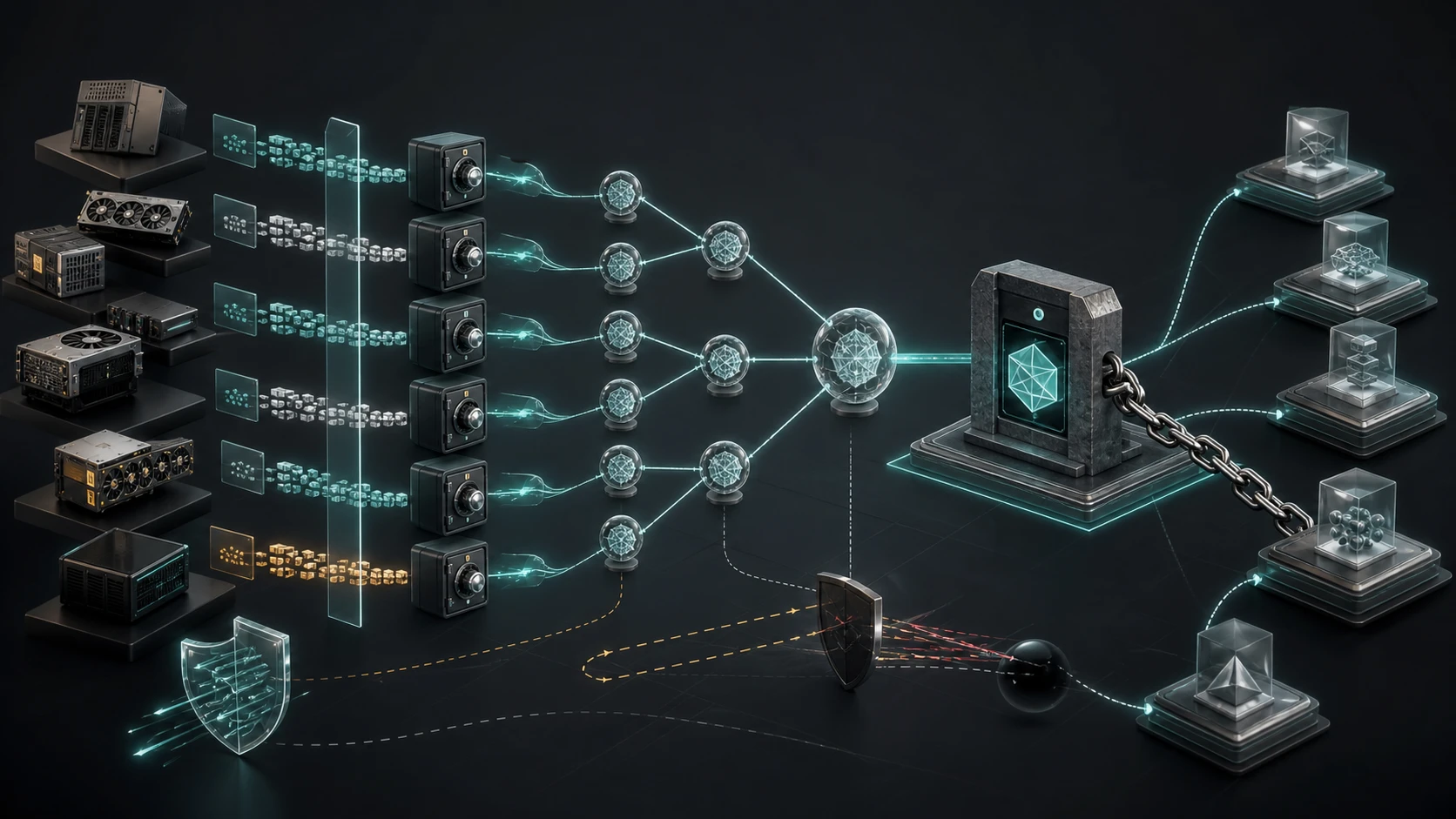
Abstract: a prover network is a settlement market, not a GPU backend
The bottleneck of a ZK rollup is often reduced to one sentence: proof generation is expensive. That is true, but incomplete. What matters for settlement, cross-chain routing, and user-visible refunds is how proof work is split, priced, committed, aggregated, verified, and disputed in an open market. A decentralized ZK prover network tries to replace the single-operator prover cluster with a market where external compute can produce proofs for rollups, zkVM applications, and recursive aggregation pipelines. That market has to solve more than performance. It has to handle useful-work accounting, task scheduling, front-running of proof results, invalid proof spam, aggregator censorship, and hardware centralization. The main conclusion of this article is narrow: Proof-of-Useful-Work is not a synonym for hash mining. It is closer to a real-time verifiable compute market with deadlines, bonds, cryptographic outputs, and settlement consequences.
System boundary: who participates, and what is not assumed
A useful model has at least six roles. The rollup or application chain is the proof requester, written as `R`. A distributor or coordinator splits the execution trace into proof tasks, written as `D`. The prover set is `P = {p1, p2, ... pn}`. An aggregator combines child proofs into a smaller recursive proof, written as `A`. A verifier contract checks the final proof against public inputs. A cross-chain exchange or routing engine consumes the resulting settlement state as a risk signal.
The adversary is not necessarily an outside attacker. A fast prover can front-run a slower prover's result. An aggregator can censor child proofs or favor related provers. A task distributor can misprice work or leak intermediate data. A sequencer can change the batch boundary and make active proving work stale. These are not the same risks as breaking the soundness of the proof system. The verifier may remain cryptographically sound while the market around the verifier becomes slow, extractive, or centralized.
This article does not describe how to implement a SNARK or STARK from scratch. It also does not treat any single project's current testnet design as a settled industry standard. Succinct, RISC Zero and Boundless, Aleo, Mina, Scroll, and Ethereum rollup documentation each expose one part of the design space: general-purpose verifiable computation, zkVM receipts, recursive proof systems, prover pipelines, and rollup settlement. Taken together, they show that the hard problem is not whether one proof can be verified. The hard problem is whether an open prover network can continuously deliver proofs that are timely, non-plagiarized, aggregatable, and punishable when invalid.
The trust assumptions must therefore be separated. The verifier contract trusts the proof system, not the prover identity. The task market relies on commitments, timestamps, bonds, and arbitration rules. The scheduler relies on network availability, hardware diversity, retry policy, and price signals. Cryptographic soundness, market liveness, and decentralization are related, but they are not interchangeable.
The task model: turning proof generation into tradable compute
A proof task can be described as:
`T_i = (programHash, inputCommitment, publicInputs, traceShard, deadline, reward, bond, domain)`
`programHash` binds the circuit, guest program, or zkVM image. `inputCommitment` binds the private witness or execution trace commitment. `publicInputs` bind the state root, batch hash, block number, or other values that the verifier will check. `traceShard` identifies the part of the execution trace being proven. `deadline` turns the task into a settlement-sensitive object. `reward` pays for successful work. `bond` gives the market something to slash. `domain` prevents replay across tasks, batches, or networks.
The proof submitted by a prover is not a claim that work was performed. It is an object that either verifies, or can be used as a child proof in a higher-level aggregation circuit. This is the first difference between Proof-of-Useful-Work and ordinary work competition. The output is useful because it is consumed by a protocol. A rollup batch can settle, a zkVM receipt can be verified, or a recursive aggregation tree can advance.
A minimal profit function looks like this:
`profit(p_j, T_i) = reward_i + urgencyPremium_i - cost(p_j, T_i) - invalidPenalty - latenessPenalty - plagiarismRisk`
The term `cost` is not stable. It depends on the proof system, hardware, memory bandwidth, parallelism, network latency, electricity, and implementation quality. A market that rewards only the fastest reveal will naturally concentrate work in the strongest hardware and lowest-latency data centers. A market that over-smooths rewards may fail to attract urgent capacity during congestion. A credible Proof-of-Useful-Work design must combine base rewards, urgency premiums, bonds, lateness penalties, invalid proof penalties, and long-run reputation. A single auction price is not enough.
Segmented proving and tree aggregation: the scheduler controls latency
A rollup proof is often not a single indivisible black box. The trace can be split by block range, transaction batch, memory segment, circuit module, or recursion layer. Each prover handles one shard. The aggregator combines child proofs into a root proof. The simplified flow is:
```text for batch B: shards = split_trace(B, policy) for shard in shards: assign_prover(shard, reward, deadline, bond) childProofs = collect_valid_proofs(shards) rootProof = aggregate_tree(childProofs) submit(rootProof, publicInputs) ```
The pseudocode hides the main engineering problem: the shape of the aggregation tree. If all shards have similar weight, a binary aggregation tree has depth near `O(log m)`. If shard weights vary, the slowest shard becomes the critical path. A scheduler must decide whether a shard should be assigned to one prover or redundantly assigned to multiple provers. Redundancy reduces liveness risk, but it raises cost. Single assignment is cheaper, but one offline prover can delay the root proof.
Finer sharding is not automatically better. It increases metadata, commitments, network traffic, and aggregation work. Coarse sharding reduces coordination overhead, but it magnifies the advantage of large provers. Depending on the proof system, the bottleneck can move between MSM, FFT or NTT, FRI queries, hash computation, witness generation, GPU memory, PCIe transfer, or proof serialization. A prover network that reports only average proof time is not giving enough information to routing systems. The useful metrics are queue depth, shard size, retry rate, aggregation delay, and p95 or p99 proof latency.
This is why the block-production game around prover networks should not be described as pure compute competition. It is a joint optimization over deadlines, redundancy, aggregation depth, reward curves, and dispute rules. A network can have more raw compute and still produce worse settlement behavior if it assigns work poorly or lets one aggregation layer become a bottleneck.
Front-running proof results: ownership must be protected before reveal
The most under-discussed risk in a proof market is result plagiarism. A slower but honest prover may compute most of the proof, leak a proof blob, intermediate object, or aggregation input, and then lose the reward to a faster node that broadcasts first. This is not AMM-style sandwiching. It is theft of attribution for verifiable computation.
A common defense is a two-phase commit-and-reveal protocol. In the first phase, the prover submits:
`C = H(taskId, proverKey, proofDigest, nonce, domain)`
and locks a bond. In the reveal phase, the prover submits the proof, nonce, and signature. The market checks that the digest matches the proof, that the proof verifies, and that the reveal happened inside the allowed window. This prevents the simplest attack where an observer copies a clear proof and submits it first.
Commit-and-reveal is not sufficient by itself. If public inputs are complete and the task is not bound to a prover-specific domain, a stronger prover can independently recompute and reveal faster. If the reveal window is too long, settlement latency increases. If the window is too short, normal network jitter punishes honest provers. More robust designs bind the proof or receipt to a prover identity, session key, or task-specific domain. In recursive aggregation, child proofs also need ownership semantics. The fact that a child proof is valid does not mean any aggregator should be able to use it to claim the reward for that shard.
There is also an intermediate-state leakage problem. Prover software should assume messages can be copied, delayed, and reordered. High-value intermediate state should not be exposed earlier than necessary. A task network should not require provers to publish polynomial coefficients, witness-derived fragments, or trace data that would allow another participant to reconstruct the result. Aggregators should receive the minimum proof object and commitments needed for validation and recursive composition.
The defensive goal is not secrecy for its own sake. It is incentive compatibility. If honest mid-sized provers repeatedly lose rewards after doing useful work, they leave the network. Once they leave, the market becomes faster in the short term but more centralized and fragile in the long term.
Hardware neutrality: not equal outcomes, but resistance to capture
ZK proving is hardware-sensitive. Groth16 and Plonk-style systems often expose bottlenecks around MSM, FFT or NTT, and polynomial commitments. STARK and FRI pipelines stress hashing, memory access, and low-degree testing. zkVM systems add trace generation, guest program execution, constraint lowering, and receipt compression. Specialized hardware is not a bug. The problem is a reward function that makes the network dependent on a small set of data centers or private optimizations.
Hardware-agnostic benchmarking should not mean pretending that hardware differences do not exist. A practical design separates work into different task classes. Urgent settlement tasks can pay a premium for the fastest provers. Long-deadline tasks can be routed to cheaper or more diverse capacity. Redundant verification tasks can keep smaller provers active. Low-priority aggregation work can tolerate longer latency in exchange for broader participation.
A possible reward structure includes:
- `baseReward`, which keeps ordinary tasks worth serving; - `urgencyPremium`, which pays for congestion and settlement pressure; - `diversityWeight`, which lightly rewards long-term uptime, network region diversity, or hardware diversity; - `slashing`, which punishes invalid proofs, unrevealed commitments, plagiarism, and malicious delay; - `reputationDecay`, which prevents early large nodes from permanently controlling priority.
Each lever has a cost. Too much diversity weighting can slow urgent settlement. Too much speed weighting can centralize the network. Strong penalties can deter edge nodes. Weak penalties invite spam and low-quality participation. The economics of Proof-of-Useful-Work are difficult because the protocol is not only buying computation. It is buying timely computation from a market that should remain open under load.
Failure modes: how a prover network can damage settlement without breaking cryptography
The first failure mode is prover withholding. A prover wins a task or receives a critical shard and then refuses to reveal. It may wait for a higher reward, try to delay a rollup batch, or force competitors to miss the deadline. Bonds, timeout reassignment, redundancy, and substitutable tasks reduce the risk, but all of them increase cost.
The second failure mode is invalid proof spam. A malicious node can submit malformed proof objects, invalid receipts, or oversized data to waste aggregator resources. Off-chain gateways need cheap prechecks. On-chain contracts need size limits and clear slashing rules. Otherwise the market turns openness into a denial-of-service surface.
The third failure mode is result plagiarism. Copying proofs, copying child proofs, or racing a reveal breaks the expected revenue of honest provers. Commit-and-reveal, proof ownership, session signatures, and aggregation authorization reduce the risk, but they also add protocol complexity and latency.
The fourth failure mode is aggregator censorship. An aggregator can ignore proofs from independent provers, delay a batch, or route rewards toward related nodes. Multiple aggregators, challengeable logs, public task histories, and transparent settlement receipts help, but they do not solve the issue if task distribution itself is centralized.
The fifth failure mode is stale proving. A rollup state root, input commitment, or sequencer output changes while provers continue working on the old task. Strict domain separation and public input binding prevent an old proof from verifying for the wrong state, but they do not recover wasted capacity. For cross-chain systems, stale proving usually does not steal funds directly. It creates delayed quotes, longer refunds, and user-visible failure states.
These failures matter because they are observable before a cryptographic catastrophe. A routing system can track unrevealed commitments, invalid proof rates, reassignment frequency, aggregation delays, and concentration of winning provers. Those signals are more useful than a binary label saying that a rollup uses ZK.
AllSwap relevance: proof latency becomes part of route pricing
In a non-custodial cross-chain exchange flow, the user sees quote, lock, settlement, and refund states. Under the hood, the routing engine has to evaluate the finality risk of each path. If a path depends on a ZK rollup validity proof, the state of the prover market becomes part of the route model. A simplified route score can be written as:
`routeScore = priceScore + liquidityScore - proofLagPenalty - proverMarketRisk - refundUncertainty`
`proofLagPenalty` comes from the current proving queue, historical p95 proof time, aggregation delay, and verifier cost on the target chain. `proverMarketRisk` comes from prover concentration, recent invalid proof rates, task reassignment frequency, and whether aggregation has a single operational chokepoint. `refundUncertainty` comes from whether the timeout and refund path remains verifiable if the proof pipeline stalls.
AllSwap does not need to expose every detail of an external prover network to users. It does need a more precise internal state model than “pending.” Useful states include `provingQueued`, `proofCommitted`, `proofVerified`, `aggregationDelayed`, and `fallbackRoute`. These states make refunds, support diagnostics, and risk logs more attributable without forcing the user to understand proof systems.
The route engine should also distinguish short-term congestion from structural prover scarcity. Short-term congestion can be handled through longer time estimates or a route with a higher urgency premium. Structural scarcity should reduce route weight or push users toward a path with clearer refund semantics. The user experiences a swap, but the system is pricing risk across multiple asynchronous finality domains.
The operational metrics matter more than branding. A route engine can consume a time series of `queueDepth`, `commitNoRevealRate`, `invalidProofRate`, `reassignmentCount`, `aggregationDelay`, and `verifiedToExecutedLag`. Each metric answers a different engineering question. Queue depth tells whether demand is outpacing available proving capacity. Commit-without-reveal tells whether provers are failing, withholding, or being mispriced. Invalid proof rate tells whether the network is under spam pressure or whether a client release introduced incompatibility. Reassignment count tells whether the scheduler is relying too heavily on retries. Aggregation delay separates child-proof production from root-proof bottlenecks. Verified-to-executed lag captures the gap between cryptographic verification and the target chain action that the user actually waits for.
These signals should not be presented as raw complexity to a retail user, but they should affect internal route selection. A path with a slightly worse nominal price may be better if its proof pipeline has lower variance and clearer refund semantics. Conversely, a path with the best spot quote may be worse if the proof market is in a high-reassignment regime. This is the same discipline that mature payment systems apply to banking rails and card networks: price is only one part of execution quality. For cross-chain settlement, proof-market health becomes part of execution quality.
The conservative implementation choice is to treat these metrics as penalties, not as optimistic bonuses. Missing data should lower confidence rather than silently improving the route.
This is the reason the topic belongs in AllSwap's research cluster. Cross-chain products do not design every external prover market, but they consume settlement signals from those markets. If a prover network exposes task logs, aggregation status, verification receipts, and failure rates, a router can treat ZK paths with finer risk grades. If it only promises that proof will eventually arrive, the router must price uncertainty into quotes, wait windows, and fallback logic.
Open problems: decentralized prover markets are still immature
First, proof quality is hard to price. The fastest proof, cheapest proof, most decentralized proof, and most auditable proof are not the same target. A protocol has to state whether it optimizes settlement speed, censorship resistance, or long-term market diversity.
Second, ownership of recursive child proofs remains subtle. A child proof can be valid without being freely usable by any aggregator for reward claims. Weak ownership rules compress small-prover revenue. Strong ownership rules can reduce aggregation efficiency.
Third, cross-rollup correlation risk is poorly measured. Several rollups may appear to use different prover markets while depending on the same hardware vendors, cloud regions, or implementation libraries. A power issue, GPU supply shock, or client bug can then affect many systems at once.
Fourth, hardware fairness cannot be solved with a slogan. Task classes, reward curves, reputation decay, and slashing parameters can all be optimized by large actors. Networks need to publish task-level latency, failure rates, reassignment statistics, and concentration metrics, not only total proof counts.
Fifth, cross-chain routers need a standard way to consume prover-market signals. The user does not care that a chain uses ZK in the abstract. The user cares whether the current path has predictable proof latency, a verifiable refund path, and an explainable failure state. Turning those signals into auditable route scoring is an infrastructure problem that still needs more work.
References
[1] Succinct, Prover Network documentation, https://docs.succinct.xyz/docs/protocol/introduction
[2] Succinct, SP1 zkVM documentation, https://docs.succinct.xyz/docs/sp1/introduction
[3] RISC Zero, zkVM documentation, https://dev.risczero.com/api/zkvm/
[4] RISC Zero, remote proving and Boundless documentation, https://dev.risczero.com/api/generating-proofs/remote-proving
[5] Ethereum Foundation, Zero-knowledge rollups, https://ethereum.org/en/developers/docs/scaling/zk-rollups/
[6] Scroll, zkEVM and proof generation documentation, https://docs.scroll.io/en/technology/zkevm/intro-to-zkevm/
[7] Mina Protocol, recursive zk-SNARKs and protocol documentation, https://docs.minaprotocol.com/
[8] Aleo, network participants and Proof of Succinct Work overview, https://aleo.org/how-aleo-works/
[9] StarkWare, recursive proving efficiency discussion, https://starkware.co/blog/minutes-to-seconds-efficiency-gains-with-recursive-circuit-proving/
[10] L2BEAT, Scaling summary and risk context, https://l2beat.com/scaling/summary
FAQ
How is a decentralized ZK prover network different from mining?
Traditional mining usually rewards generic hash competition. A decentralized ZK prover network rewards proofs that a rollup, zkVM, verifier contract, or recursive aggregation pipeline can directly consume. The work has public inputs, deadlines, verification rules, and penalties.
Can proof-result front-running directly steal user funds?
Usually no. It does not bypass the validity proof. But it can damage honest prover economics, increase proof latency, trigger task reassignment, and create more refund or quote risk for cross-chain exchange routes.
Why does a prover network affect cross-chain route pricing?
If a route depends on a ZK rollup validity proof, the proving queue, aggregation delay, and verification state affect final arrival time. A router should price proof lag, prover concentration, and refund certainty into its risk model.
Does stronger hardware always make a prover network safer?
Stronger hardware can reduce single-proof latency, but a reward function that only favors the fastest reveal can concentrate work in a few data centers. A resilient market needs explicit trade-offs between speed, cost, diversity, and auditability.
Sources & references
- Succinct Prover Network documentation
- Succinct SP1 zkVM documentation
- RISC Zero zkVM documentation
- RISC Zero remote proving and Boundless documentation
- Ethereum Foundation Zero-knowledge rollups
- Scroll zkEVM and proof generation documentation
- Mina Protocol documentation
- Aleo network participants and Proof of Succinct Work overview
- StarkWare recursive proving efficiency discussion
- L2BEAT scaling summary