

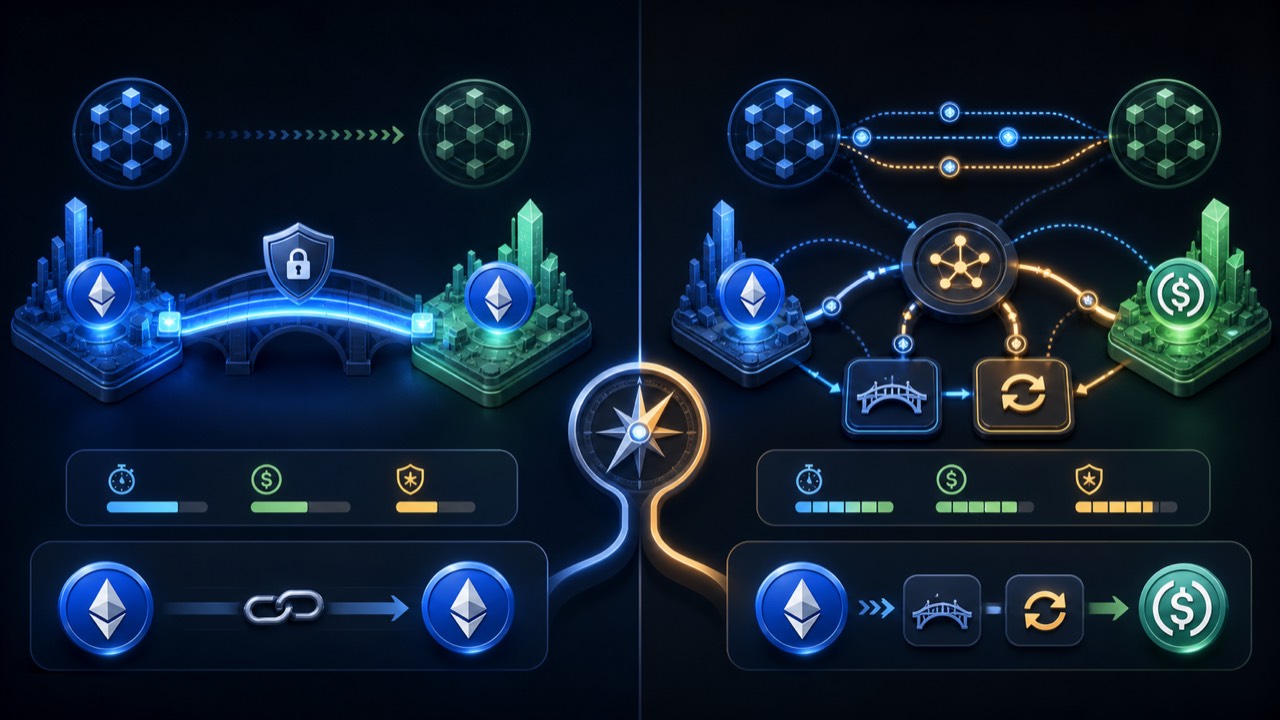
What each one actually does
A bridge takes a token on Chain A and gives you a representation of the same token on Chain B — either the canonical version (e.g. ETH on Arbitrum, native) or a wrapped IOU (e.g. wETH minted by the bridge contract). Same asset, different home network.
A cross-chain swap also changes the token. Under the hood it composes a bridge transfer with one or more DEX trades, so you end up with a different asset on a different chain — in a single user-facing transaction.
When a bridge is the right tool
Use a bridge when you just need the same asset on another chain. Examples: moving ETH from Ethereum to Arbitrum to deploy a contract; moving USDC-ERC20 to Solana so you can swap it on Jupiter; consolidating stablecoins for treasury operations. The path is simpler — one hop, fewer moving parts, fewer fees.
When a cross-chain swap is the right tool
Use a cross-chain swap when the asset on the destination chain is different from what you're sending. Examples: ETH (Ethereum) → USDC (Base) to take profit; USDT-TRC20 → BTC-Bitcoin to rotate into majors; SOL → USDC (Ethereum) to enter a Curve pool. You save the separate DEX trade and the second round of gas on the destination chain.
Costs: bridge vs swap, head-to-head
Direct bridge cost = source-chain gas + bridge fee (usually 0.05-0.30% of value) + destination-chain finalization (if applicable). Cross-chain swap cost = source-chain gas + combined bridge + DEX spread (usually 0.3-1.0% all-in). For a 1 ETH → USDC-Base trade, the two methods are usually within $1-5 of each other after you account for the second DEX trade you'd need with the bridge-only path.
An aggregator typically saves 10-40% versus picking a single bridge or single DEX, because it's comparing many routes in real time. The savings are bigger for unusual pairs (DOGE → BNB-on-BSC) than for popular ones (ETH → USDC).
Risk: bridge vs swap, head-to-head
The single biggest risk vector for cross-chain has historically been bridge contracts holding pooled liquidity — Ronin, Wormhole, Nomad together lost over $1B between 2022-2023. A bridge sits in this category by definition; a cross-chain swap sits one layer above it. Aggregators reduce risk by spreading volume across many bridges (so no single venue holds all your funds in transit) and by routing through audited venues; they don't eliminate it.
Non-custodial routing is the other side of the risk picture: with AllSwap and most modern aggregators, funds leave your wallet only when you send to the one-time deposit address, and are auto-refunded if the route can't complete.
TL;DR decision guide
Same asset, different chain → use a bridge.
Different asset, different chain → use a cross-chain swap.
Either way, use an aggregator if one is available for your pair — it compares 20+ underlying routes and almost always finds a better price than picking one bridge yourself.
FAQ
Is bridging cheaper than a cross-chain swap?
Only if you'd be content with the same token on the other chain. The moment you also need to change the token, a cross-chain swap is almost always cheaper than bridging + a separate DEX trade — because the aggregator can batch the bridge and the swap into one optimized path.
Can I bridge then swap manually?
Yes, and you might do this if you want fine control over each step or you have very chain-specific liquidity preferences. For everyday use, a one-step cross-chain swap saves the manual coordination — and usually a few dollars in gas.
Is one safer than the other?
All else equal, a single bridge contract concentrates risk in one place. Aggregated cross-chain swaps spread the same trade across many smaller transfers — no single venue ever holds your full position in flight. That's the structural difference; specific bridges and aggregators still differ in audit history and operational track record.